
Limestone Release Date Meaning
A release date is not one universal field. In the Limestone County Jail portal, a visible Release Date is generally evidence that the person has already left local jail custody. The research did not find a county portal field that computes a future release date for local pretrial detainees. That makes local jail release timing more dependent on bond, court orders, holds, and records staff than on a public calculator.
For ADOC state prisoners, the phrase to use is "Minimum Release Date." ADOC defines that field as the earliest scheduled date an inmate can be released to probation or end of sentence. It can change if good time is lost through discipline, if the circuit clerk sends new cases, or if the sentence changes. A Limestone County inmate release date may therefore be a posted past jail release date, an ADOC minimum release date, a parole consideration date, or a court-driven jail release event.
Scheduled vs actual: An ADOC minimum release date is an earliest scheduled date. A county jail Release Date is usually a posted custody-change date after release.
Where Limestone Release Dates Appear
The right search source follows the type of custody. A person released from the Limestone County Jail should be checked through the sheriff portal, sheriff records or detention staff, and the court docket. A person released from Limestone Correctional Facility should be checked through ADOC, ABPP if parole or supervision applies, and Alabama VNS for notifications. A person held for U.S. Marshals or ICE may appear locally for a time, but the federal or immigration system controls final release status once that agency takes custody.
| Release-date question | Best first source | What the date means |
|---|---|---|
| Has a Limestone County Jail detainee been released? | Sheriff portal Release Date filter and records staff | Usually a posted local jail release date, not a future calculation |
| When can an ADOC inmate leave? | ADOC inmate search and definitions | Minimum Release Date, the earliest scheduled release to probation or end of sentence |
| When will parole be considered? | ABPP hearing resources and FAQ | Parole Consideration Date or set date, not a guaranteed release |
| Did court action change the date? | Limestone Circuit Clerk and Alacourt | Sentence, jail credit, bond, order, warrant, or disposition detail |
Find a Limestone Release Date
Start with identity and custody. A same-name match is not enough. Use the full legal name, date of birth if known, booking date, ADOC AIS number, court case number, or held-for agency when available. For a local jail release, use the county release-date workflow on Limestone County released inmates. For a state-prison release, use ADOC and then verify any supervision outcome with ABPP.
- Decide whether the person is in Limestone County Jail, ADOC custody, federal custody, ICE custody, or post-release supervision.
- For county jail, open the sheriff-linked Zuercher/CentralSquare portal and use name plus the Release Date filter when checking a known date.
- For ADOC, search by AIS number if known. ADOC says the six-digit AIS number takes precedence over name fields.
- Read ADOC's Minimum Release Date, Parole Consideration Date, Parole Status, jail credit, good-time fields, and sentence fields together.
- Check ABPP hearing and results resources if parole could affect the date.
- Use the Limestone Circuit Clerk or Alacourt when jail credit, sentence, bond, disposition, or court orders may control the timing.
For a pretrial county-jail detainee, no public projected-release date may exist. The person may leave after bond is posted, a judge signs an order, a hold is cleared, time served is credited, or a transfer is completed. In that setting, the jail records line and the court docket are more useful than a projected release-date page.
ADOC Minimum Release Date
The Alabama Department of Corrections inmate search is the state source for current ADOC custody and release-date information. It is not the primary source for a short county-jail stay unless the person was sentenced or transferred to ADOC. ADOC's search is built around the AIS number and name fields. ADOC says name fields are open-ended, so a partial last name can return names beginning with that text.
The screenshot below is from the ADOC offender search page. It is included because Limestone County release-date searches often involve Limestone Correctional Facility, an ADOC prison in Harvest, and the county jail portal does not compute state-prison dates.
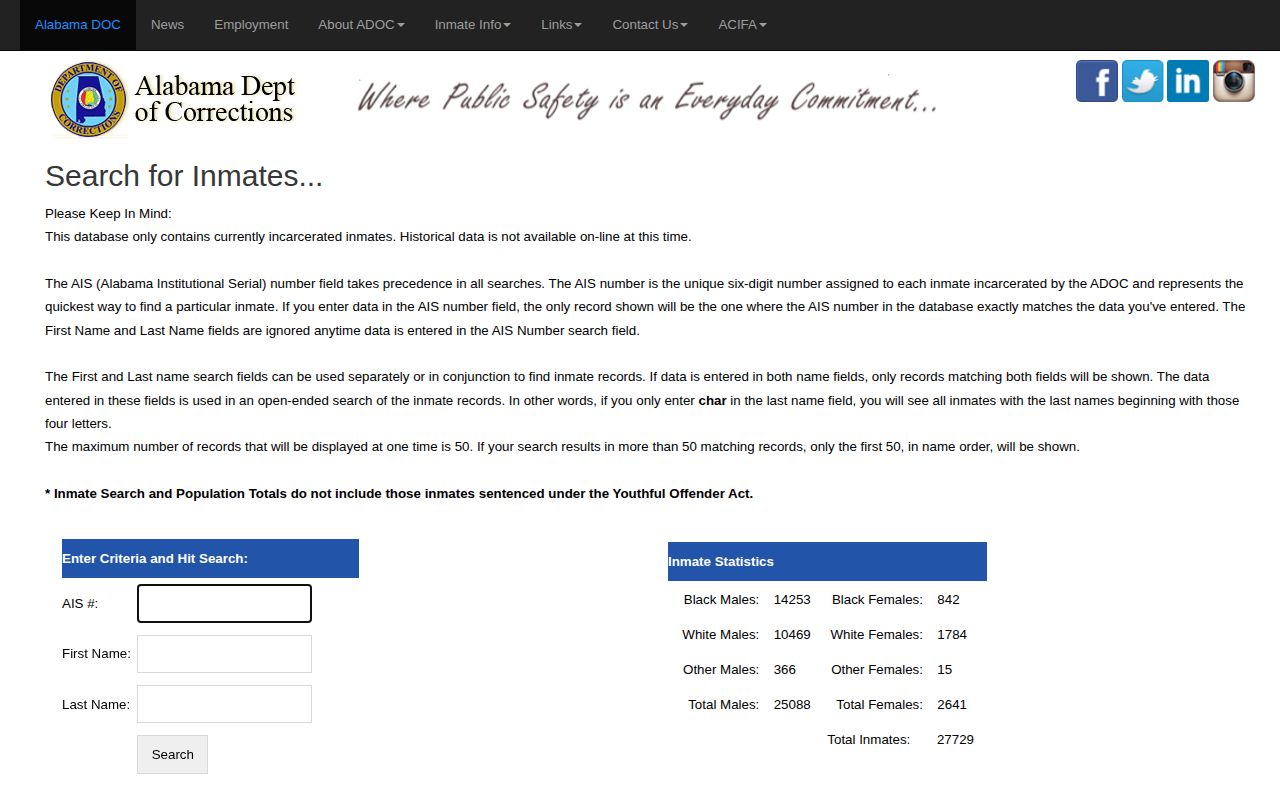
Use ADOC search results with ADOC's definitions. A state-prison release from Limestone Correctional Facility is not confirmed through the Limestone County Jail roster unless the same person also had a separate local booking.
| ADOC field | Release-date use |
|---|---|
| AIS number | Fastest ADOC identity key and stronger than a name-only search |
| Minimum Release Date | Earliest scheduled date for release to probation or end of sentence |
| Parole Consideration Date | Tentative board timing, not the same as release |
| Jail Credit | County-jail time credited toward the sentence, prepared by the sentencing circuit clerk |
| Good Time Received / Revoked | Sentence-credit fields that can move the release date earlier or later |
Alabama Good-Time Rules
Alabama Correctional Incentive Time is governed by Ala. Code 14-9-41. The research records the current statutory categories this way: eligible Class I prisoners receive 30 days for each 30 days actually served, Class II receive 15 days for each 30 days, Class III receive 5 days for each 30 days, and Class IV receive no correctional incentive time. That is why an inmate release date cannot be worked out by simply counting calendar days from sentence start.
The same research notes major exclusions. Certain prisoners cannot earn correctional incentive time, including Class A felony convictions, death or life sentences, sentences over 15 years, certain deadly-weapon death cases, and child sex offenses as defined by statute. Alabama truth-in-sentencing materials also show that some sentences include a minimum and an extended term with post-release supervision. The safe reading is that Alabama does not have one public "85 percent" rule that applies to every inmate. Release-date work must follow offense class, sentence type, eligibility, jail credit, discipline, parole action, and court orders.
Good time also has to be read with ADOC classification. Class I, Class II, Class III, and Class IV are not just labels in a table; they change the amount of credit an eligible prisoner may earn. A disciplinary event can reduce or revoke credit, and ADOC definitions identify good time received and good time revoked as separate fields. For a Limestone County inmate release date, those fields can explain why two people with similar sentence lengths do not have the same minimum date.
The ADOC definitions page is the source for minimum release date, parole consideration date, jail credit, good time, and parole status. The screenshot below supports the field vocabulary used in Limestone County inmate release date checks.
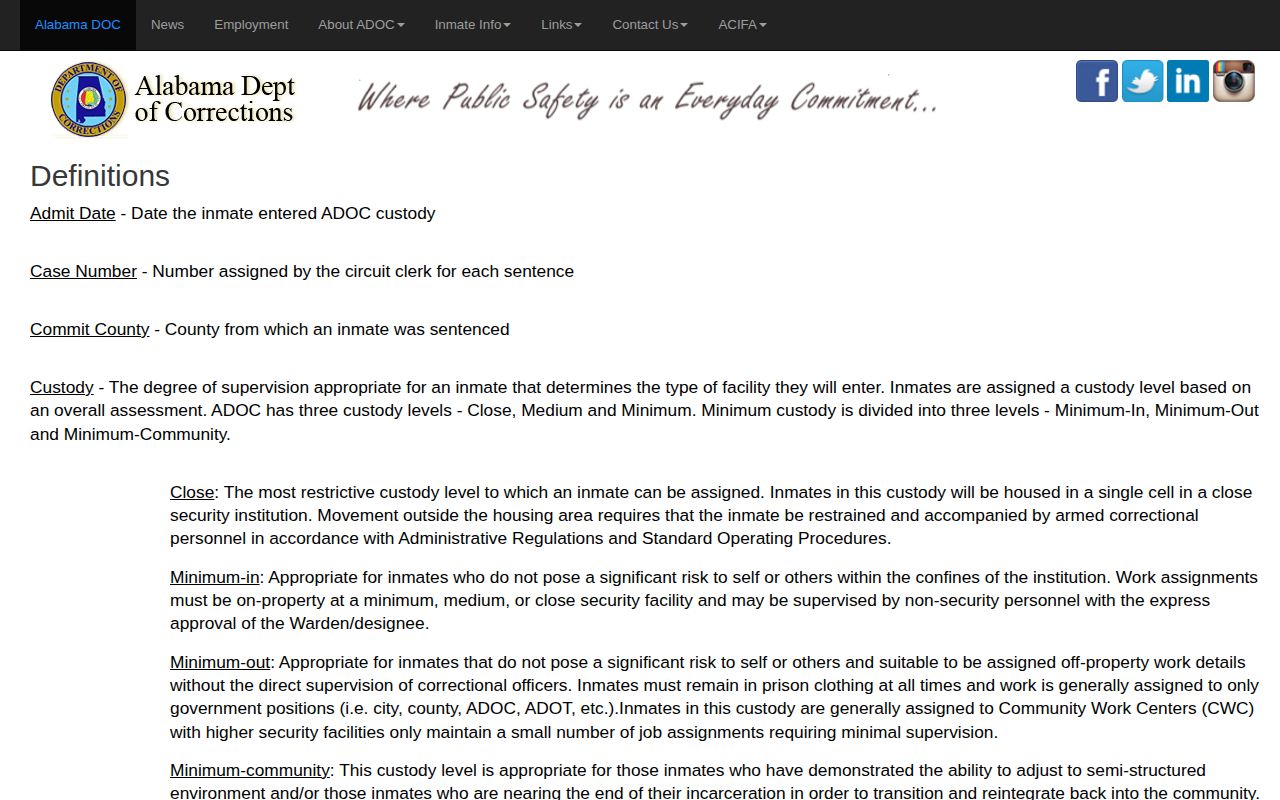
Because ADOC says jail credit is prepared by the sentencing county's circuit clerk, a Limestone County sentence may require Limestone Circuit Clerk review if the jail-credit calculation is the source of the dispute.
Limestone Parole Date Limits
ABPP parole dates should not be read as actual release dates. ABPP says eligibility consideration is calculated under Ala. Code 15-22-28(e), and sentence, crime, jail credit, ability to earn good time, time served, and court orders can all affect eligibility. Once the calculation is made, the inmate receives a letter with a parole consideration eligibility date or set date. ABPP says the set date does not guarantee a hearing in that month.
ABPP's current-year results page also explains that a reset date is the first month or year the person will be considered for placement on a future docket, not the date of a new hearing. That nuance is central for Limestone County inmate release date searches. A parole grant may lead to release after conditions and processing. A denial or reset means the parole hearing did not create an immediate release. Use Limestone County parole and probation information for the supervision side after release.
Mandatory release is another state-prison term, not a county jail bond term. ABPP's FAQ addresses mandatory release under Ala. Code 15-22-26.2 for eligible offenses committed on or after January 30, 2016, while also identifying exclusions for child sex offenses and life sentences. A person released under that state mechanism may still have reporting duties after leaving prison. The release date answers when custody changed; the supervision record answers what rules remain.
County Jail Release Timing
The Limestone County jail path is different from the ADOC calculation path. The public portal has a Release Date filter and Release Date column, but the research did not find a future projected-release field for local detainees. A person in pretrial custody may leave after bond, court order, dismissal, sentence to time served, transfer to ADOC, transfer to another county, ICE pickup, U.S. Marshals pickup, or another hold decision. Some of those events are legal decisions, not jail calculations.
For that reason, the court record is often the best companion to the jail release date. The Limestone Circuit Clerk and Alacourt records can show the charge path, disposition, probation order, sentence, warrant recall, or other order that explains why the jail date changed. If the public portal does not show a recent release, use records staff for the booking/release record and the court record for the legal outcome. The jail release date proves custody changed at the local facility; it does not prove the case ended.
Why Limestone Release Dates Change
Release dates move because custody records are not static. A minimum date may change after discipline. A court may add a sentence, correct jail credit, or issue a new order. A detainer or hold can prevent release to the community even when one custody term ends. A parole result can grant release, deny release, set a future date, or impose conditions that must be processed.
| Change factor | How it affects the date |
|---|---|
| Good-time loss or restoration | ADOC discipline or credit changes can move the minimum release date. |
| New cases or detainers | New charges, warrants, holds, ICE, U.S. Marshals, or another county can block release to the community. |
| Jail credit correction | The sentencing circuit clerk's jail-credit calculation can change the ADOC time computation. |
| Court order | Bond, sentence, dismissal, time-served order, or warrant recall can create or change a county release date. |
| Parole board action | Grant, denial, reset, rescission, or conditions can affect when release happens. |
| Portal timing | Public jail or notification systems may lag actual booking or release processing. |
Note: A release from one agency can be a transfer to another agency, not release from all legal custody.
Confirm Limestone Release Dates
Actual release confirmation should come from the source that controls the custody. For a county-jail release, use the Limestone County Sheriff's Office portal and records or detention staff. For a state-prison release, use ADOC and ABPP when supervision applies. For future custody-change alerts, use VINELink release check steps when the Alabama source record supports notification. For sentence, bond, disposition, jail credit, and expungement details, use the Limestone Circuit Clerk or Alacourt.
Alabama public-records law gives a baseline access path, but requests should stay narrow. Ask for one person's booking/release record, sentence document, or release/discharge record for a narrow date range. Public access can still be limited by sealed or expunged records, juvenile or Youthful Offender restrictions, confidential investigative material, protected personal information, or another statute.